A face-to-face workshop for middle and high school teachers of every subject. Instead of a lecture about engagement, teachers do each strategy first, then name it, see it in a real classroom, and plan where to use it.
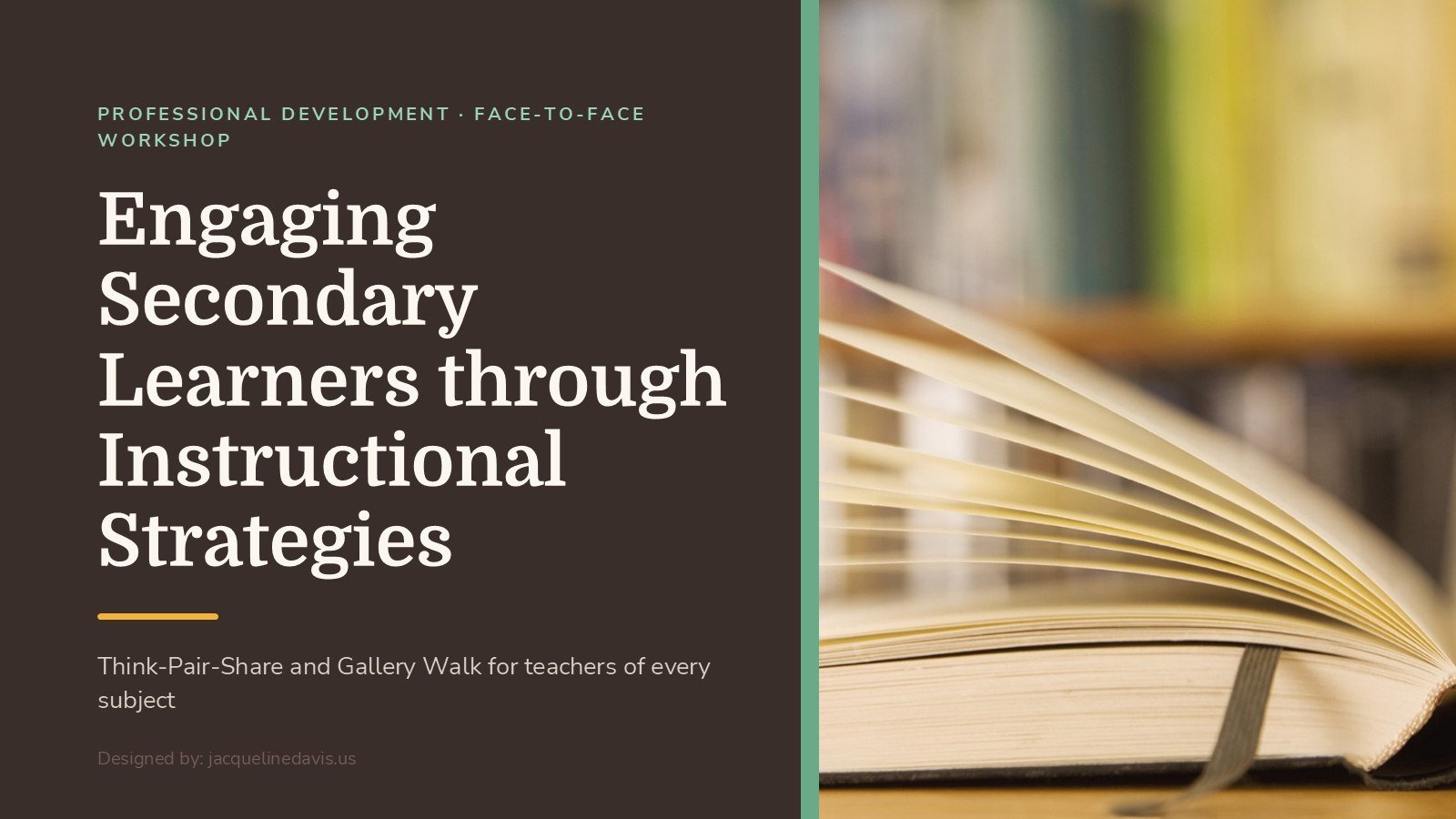
The workshop deck, designed with facilitator notes for every slide.
Most teachers already know engagement strategies. Between curriculum requirements, pacing, and compliance checklists, those strategies get lost, and lessons slide back into lecture. A PD session that lectures about engagement repeats the same problem.
A presenter explains strategies teachers have heard before. Familiar, passive, and easy to forget by Monday.
Teachers leave having practiced two strategies as learners, with a plan to use one in an upcoming lesson.
The session models the strategies it teaches. Each one follows Kolb's experiential learning cycle: do it, reflect on it, make sense of it, then plan to use it.
Teachers answer "When did you struggle to keep students engaged?" through Think-Pair-Share, then move between posters in a Gallery Walk, before either strategy has a name.
Volunteers share their discussion with the room, drawing on their own classroom experience.
The facilitator reveals the strategy, walks through its steps, and plays a short video of a teacher using it with students.
Pairs name one place in an upcoming lesson to add the strategy. The wrap-up asks every teacher to pick one lesson and add one strategy.


Six objectives move from Identify and Explain to Implement, Evaluate, Address, and Create, so teachers go from recognizing a strategy to shaping their own classroom with it.
Why: Knowing a strategy isn't the goal. Using and judging it in your own room is.Both strategies work with paper, posters, and a question, so they carry from algebra to art.
Why: A strategy that needs new tools or prep time rarely makes it into a busy week.Selected slides from the deck. Every slide has facilitator notes with timing, prompts, and video links. Select any slide to view it larger.


The session drew strong feedback, including from veteran teachers. Paraphrased from participants:
Even though the strategies were familiar, doing each one made the session engaging and memorable.
It reminded me of the basics in a new light. I'd been getting lost in checking boxes for the course, school, and curriculum, and engaging learners had gotten lost in lectures.
Building on this session, I'm designing a series for secondary teachers that uses the same experience-first approach. Each workshop is grounded in an established learning strategy.
I'd love to hear what your teachers need and design a session they experience, not just sit through.
Let's talk